

What is the charm of China's railway to Vietnam?
Release time:
2020-10-13 09:08
Source:
China Railway 95306
At this moment
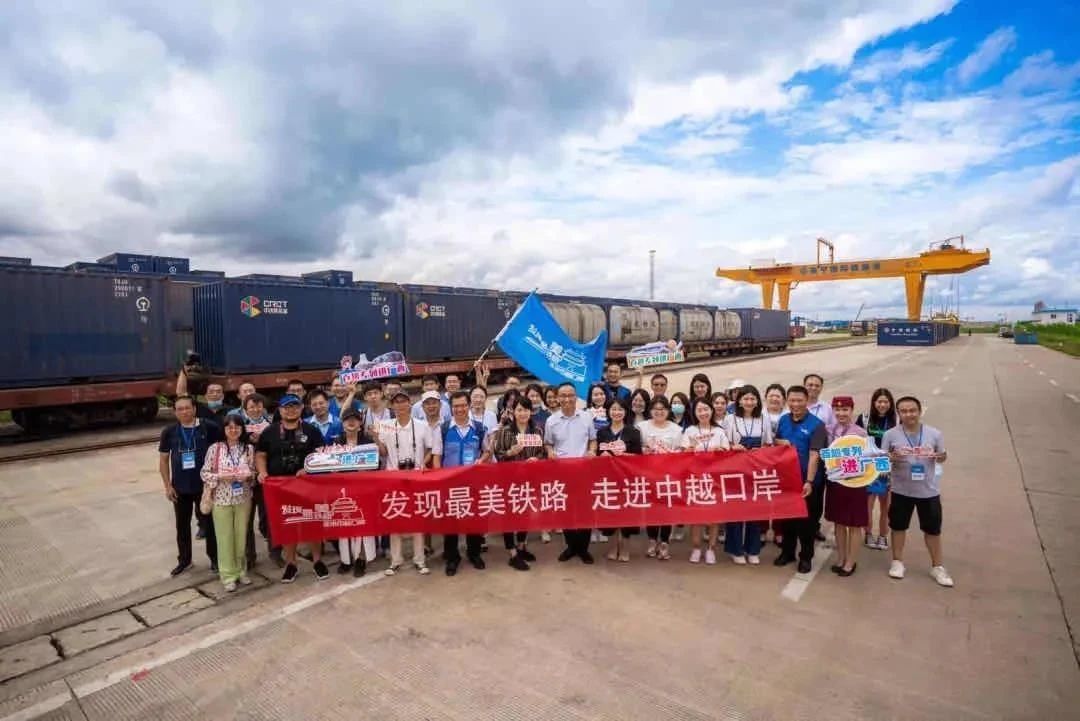
“Discover the Most Beautiful Railway · Entering Sino-Vietnamese Port"Activities
is in hot progress
In the last two days
Walk onBagui RailwayThe most beautiful discovery group
Which railway scenery have you clocked in?
What railway stories did you encounter?
Let's take a look together
First stop:
Home of Land Aircraft Carrier-Nanning EMU
At 9: 00 a.m. on September 22, the discovery group clocked in Nanning bullet train station. The EMU is located in Pangu Road, Xianhu Avenue, Qingxiu District, Nanning City, covering an area of 1045 acres. It is the first "EMU 4S shop" in Guangxi ".
The overhaul depot is equipped with 6 bullet train overhaul lines, 36 storage lines and 89 sets of bullet trains, accounting for 66% of the total number of bullet trains assigned by Nanning Bureau Group Company. The main assigned models are CRH2A and CRH380A sets, which are important hubs and transportation nodes of the southwest railway network.
At present, the newly-built Nanning No.2 bullet train station covers an area of 799 mu and adopts the east-west vertical secondary yard layout. It is planned to build 6 inspection depot lines and 30 car storage lines, with a planned maintenance capacity of 36 groups per day. It is expected to be delivered for use by the end of 2020.
Second Station:
Explore Nanning International Railway Port
Nanning International Railway Port is a first-class railway logistics base planned and constructed by China National Railway Group Co., Ltd., and it is a landmark major industrial project in Guangxi to implement the strategy of strengthening the capital.
Since September 2019, Nanning International Railway Port has been operating China-Vietnam trains and testing multiple domestic train lines on a regular basis, gradually consolidating its position as the core hub of multimodal transport based on road-rail, air-rail and sea-rail transport to meet the needs of rapid distribution and efficient entry and exit of goods.
Here, the discovery group ran into a consignor, who was Peng Qilin, general manager of Yuntianhua Tianchi Logistics Co., Ltd. Peng Qilin said, "Here, the turnover of waterways, railways and highways is more convenient, which is also in line with our company's strategic positioning. Our goods are sent here by train for containers, and then sent by rail to the port for shipment, mainly to Australia, Brazil and India."
Third Station:
5511 Slow Trains Full of Feelings"
In 1953, the South Line was opened for operation. Since then, the 5511/5512 train from Nanning to Pingxiang has shuttled between Bagui and the "South Gate of the Motherland" for 67 years. It is the only "slow train" at the Sino-Vietnamese border ".
Eight hard-seat carriages, 220 kilometers away, with an average speed of 40 kilometers per hour, five hours in the whole journey, eight stops, and the fare for the whole journey is 29.5 yuan. This bus is a car for residents along the route to get rich, visit relatives, and a school car for students. It allows people along the route to enjoy the reform dividend and promotes local economic and social development and poverty alleviation.
Chen Jingjing, a college student, sat alone in her seat, holding a book freely and occasionally eating a snack. She often takes this slow train to and from her home in Nanning and the university in Chongzuo. She takes it once or twice a month, and two years have passed. She said that this bus can free her from the fast-paced life and study, and she likes this feeling very much.
The fourth stop:
The fourth-class station on the South Line-Qujiu Station
Qu Old Station is a fourth-class station on Nanping Line. There are no full-time post passengers in the small station. Only a few dozen passengers take and get off the bus every day. On weekdays, the small station is slightly deserted, and there are not many passengers coming to take the bus, but on weekends, especially the Spring Festival, March 3 of the Zhuang nationality, National Day and other holidays, the small station has become one of the busiest places in the town.
At about 1 pm every day, the old station will welcome the only 5512/5511 passenger train that stops back and forth for residents along the line and employees of railway public works, electricity and other units to and from get off work.
Fifth Station: Pingxiang Station
Pingxiang Station, located in the southern border of the motherland, is a national first-class port station for China and Vietnam to carry out railway passenger and freight transport, which is under the jurisdiction of Nanning Depot.
Pingxiang station is located in Youyi Town, Pingxiang City. It was built in 1939 and covers an area of 4100 square meters. It is composed of station building, platform and Pingxiang (railway) port passenger inspection building.
The technical level of the station is a second-class station, and its business nature is a comprehensive passenger and freight combined border station. It is a national first-class port station connecting my country's railway with Vietnam's railway. It is the most convenient railway channel from China to ASEAN and mainly provides import and export materials. And railway transportation services for entry and exit personnel.
Due to its special geographical location, Pingxiang Station has set up a Vietnamese translation team. After the outbreak of xinguan pneumonia, cross-border passenger trains between China and Vietnam were suspended, but cross-border international freight trains remained in operation, and the translation team has been sticking to their posts. Li Wisdom is one of them.Li Zhihui's task is to provide Vietnamese translation support for the handover of international intermodal buses and trucks between China and Vietnam. As a "post-90s" translator, she always stuck to her post during the epidemic, leaving the country at most three times a day to Tongdeng, Vietnam for handover work. In Li Zhihui's view, the words and deeds of the translator represent the image of China's railway.
At Pingxiang Station, there was a pair of "father and son soldiers" who did not change their mind at first and relayed to guard the southern border.
The "post-90s" young man's agricultural ancestor was a person who "hung" on the train. He joined the army and changed jobs. He entered Pingxiang Station at the age of 19 and worked all the way from a train brake to a link. Nong Dezheng, the father of Nong Zu, retired on September 1, 2019. He used to be a freight attendant at the station. He handled the handover procedures for the international intermodal freight trains between China and Vietnam every day, and arranged for vehicles to enter or leave the country.
At the beginning of this year, the sudden epidemic broke the tranquility and harmony of Pingxiang Station. Nongdezheng volunteered to take on the important task of measuring the temperature of station personnel and did his best for the prevention and control of the epidemic.
The sixth stop:
Exploring the National Railway Pingxiang Port Logistics Center
At the sixth stop, the discovery group came to the National Railway Pingxiang Port Logistics Center, which is located on the northeast side of Pingxiang Station. It is a national first-class port and is currently the only border railway port in Guangxi.
The National Railway Pingxiang Port Logistics Center is the first railway logistics center of a port nature in Guangxi, and it is also the first land railway port logistics center opened by the new international land-sea trade channel. It promotes the in-depth development of China-ASEAN interconnection and better serves The construction of the new international land-sea trade channel provides a solid transportation foundation guarantee.
At 11: 48 on September 23, the discovery delegation witnessed the 58th return trip of the Sino-Vietnamese container cross-border train and the 105th return trip of the whole year from the national railway Pingxiang railway port logistics center to Chongqing tuanjie village to take over the Sino-European train. Previously, the train was loaded with electronic products from Pingxiang.
The Sino-Vietnamese cross-border (Nanning-Hanoi) container train was successfully launched on November 28, 2017, with obvious results, with 59 trains in 2018 and 111 trains in 2019. The train has become an important international logistics platform for Sino-Vietnamese trade.
The Seventh Station:
Entering the Railway Terminal of Hunan-Guangxi Line
The Nanning-Pingxiang section of the Xianggui Line is an important railway passage connecting China-ASEAN. Because it is located in a typical area with fully developed karst landforms, coupled with rainy and humid weather in the south, natural disasters such as collapses, landslides, and dangerous rocks are prone to occur along the line., Which poses a challenge to the safety and smooth flow of the Guomen Railway.
In order to renovate various dangerous rocks, rockfalls and water hazards along the railway, there is a flood control and renovation construction team of more than 200 people, who are active on the 5819-kilometer railway line of Nanning Bureau Group Company all the year round. They are stationed deep in the mountains and are known as "special forces for flood control".
The rails here are different from ordinary rails. In the two rows of rails, there is a single row of rails extending far away. "The gauge of Vietnam is different from that of China. The gauge of most sections is 1000mm. We call this kind of narrow-gauge railway as 'meter-rail'. In 1972, the south section of Xiang-Gui line was changed from meter-gauge and standard-gauge to mixed-track-'three-track' railway." Yang Zhiming, the old foreman of Pingxiang Line Workshop in Nanning Depot, said.
Sino-Vietnamese Port